Most families get the best experience by using trains on simple days and private transportation on the days with the most transfers, walking or luggage.
| Family situation | Usually the better starting choice |
|---|---|
| Parents with older children and light bags | Train |
| Baby or toddler with stroller and supplies | Private car for demanding days; train for simple direct routes |
| Family with grandparents | Private car for full sightseeing days |
| Group of six to nine | Compare one vehicle with multiple train fares or taxis |
| Mount Fuji day trip | Private car when visiting several stops |
| Central Tokyo along one rail line | Train may be faster and cheaper |
| Arrival with many suitcases | Airport transfer |
| Kyoto with several districts | Private car can reduce bus and train transfers |
Japan is easy to travel around - but family travel is different
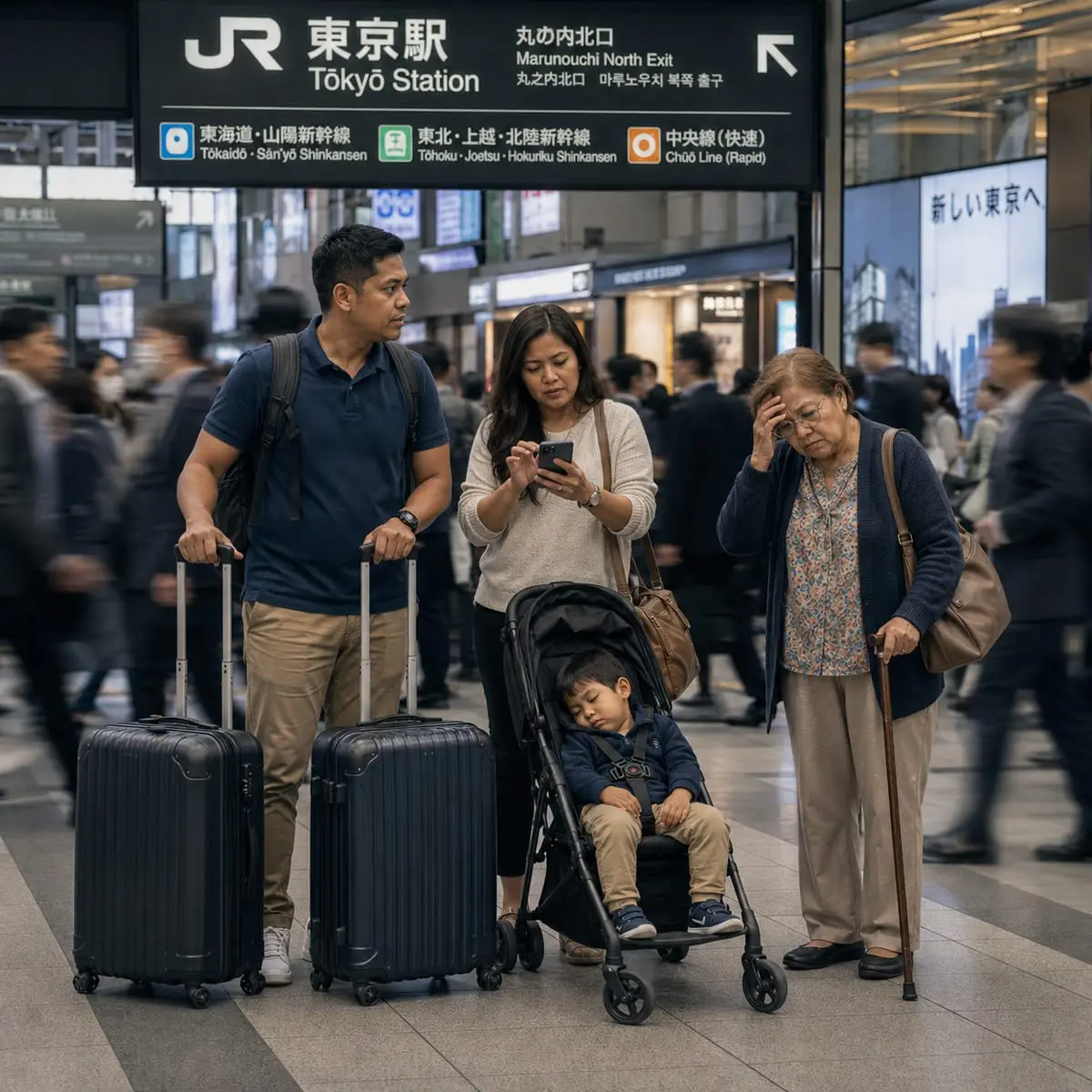
Japan’s trains are efficient, but the train ride itself is only one part of a family journey. Parents also need to reach the station, find elevators, manage a stroller, carry snacks and bags, keep children together, change platforms and walk from the destination station to the attraction.
A route that feels simple for two adults can become tiring with a sleeping toddler, a diaper bag, shopping, grandparents and a crowded evening transfer. The right question is not whether Japan has good trains. It is whether the complete door-to-door journey fits the family.
When trains are the better choice
Trains are usually the best option when the route is direct, the family is traveling light and the children can walk or remain comfortable in a compact stroller.
- Travel between major cities by Shinkansen.
- A short journey between well-connected Tokyo districts.
- One or two attractions located beside major stations.
- A small family with older children and minimal luggage.
- Days when road traffic is expected to be severe.
- Families that enjoy navigating independently and want the train experience.
- Budget-focused days where door-to-door service adds little value.
Children may enjoy trains, station signs and the Shinkansen as part of the trip. A private vehicle should not remove experiences that the family genuinely wants.
When a private car becomes more practical
- The family includes a baby, toddler or senior grandparent.
- The group has a stroller, several bags or mobility equipment.
- Six to nine people need to stay together.
- The day includes several attractions in different districts.
- The destination requires local buses or scattered rural stops.
- Children need flexible rest, meals or restroom breaks.
- The family wants hotel pickup and a coordinated return.
- Shopping bags would be difficult to carry through several transfers.
The vehicle provides a private base between stops. Children can rest, jackets and approved belongings can remain inside, and the family avoids repeatedly reorganizing on platforms. The service remains subject to traffic, parking, tour duration and practical vehicle capacity.
Babies and toddlers
Families with babies and toddlers carry more than passengers. A stroller, diapers, milk, snacks, clothing, toys and a changing bag can turn every station transfer into a logistics task. A private vehicle is often worth considering for long sightseeing days and airport transfers.
Private-car advantages for very young children
- Hotel pickup
- Fewer stroller folds and unfolds
- Space for supplies when vehicle capacity permits
- Flexible meals and restroom stops
- A place to rest between attractions
- Easier return when the child becomes tired
Important limitations
- Child seats must be requested and confirmed in advance.
- A sleeping child may still need to be moved at attractions.
- The vehicle cannot enter pedestrian areas or temple grounds.
- Traffic can extend the time inside the vehicle.
- Stroller and luggage size may reduce passenger capacity.
School-age children and teenagers
Older children can usually handle trains, but motivation and attention still matter. A day of repeated scenic viewpoints may be less engaging than a route with one interactive attraction, a meal they enjoy and enough time to explore.
Teenagers may prefer the independence and energy of Shibuya, Harajuku, Akihabara or Osaka. For them, a private vehicle can be useful on cross-city shopping days but unnecessary when the family wants to explore one district freely.
Traveling with children and grandparents
Multigenerational travel should be planned around the person with the lowest stamina, not the youngest or fastest traveler. A private car helps keep the group together and reduces station walking, while the itinerary should still limit the number of attractions.
| Need | Planning response |
|---|---|
| Toddler nap | Protect a quiet driving period or return earlier. |
| Grandparent walking limit | Choose fewer, more accessible attractions. |
| Different food preferences | Use a flexible lunch location with several options. |
| Large group | Confirm vehicle and luggage capacity, not only seat count. |
| Mixed interests | Select one cultural, one modern and one relaxed stop. |
Strollers on trains and in private vehicles
A stroller can be used in Japan, but station elevators may be far from the most direct route and crowded trains may require the stroller to be folded. Compact strollers are easier than large travel systems.
Before booking a private vehicle, report:
- Whether the stroller folds
- Approximate folded dimensions
- Number and size of suitcases
- Number of passengers
- Whether a wheelchair or child seat is also needed
A nine-passenger vehicle does not necessarily carry nine passengers, a large stroller and nine large suitcases comfortably. Practical capacity should be confirmed from the complete load.
Child seats
Child-seat arrangements depend on the child’s age, size, vehicle and supplier. Parents should request the seat before booking confirmation and receive written confirmation of availability and any charge.
- Provide the child’s age, height and approximate weight when requested.
- Confirm how many child seats are needed.
- Ask whether the seat affects passenger capacity.
- Do not assume the same rules or equipment as the family uses at home.
- Allow additional boarding time when several children use seats.
Luggage and airport days
Arrival and departure days are among the strongest reasons to use private transportation. The family is tired, unfamiliar with the route and carrying the maximum amount of luggage.
- Confirm flight, terminal, hotel and passenger count.
- Report every large suitcase, stroller and mobility device.
- Allow time for immigration, baggage collection and customs.
- Avoid planning a full city tour immediately after a long flight.
- Use luggage forwarding between cities when it reduces station stress.
Avoid rush hour when possible
Tokyo and Osaka commuter peaks can be difficult with young children, strollers and several bags. When using trains, start after the busiest morning period or plan a nearby first activity. When using a private car, remember that the same rush period can affect road traffic.
There is no mode that completely removes congestion. The family should decide whether crowded platforms or road delays are the more manageable inconvenience for that specific day.
Tokyo with children: train or private car?
Trains are excellent for direct routes between major districts. A private vehicle becomes more useful when the itinerary connects distant areas, the family plans to shop, grandparents are joining or young children need a flexible pace.
| Tokyo day | Recommended approach |
|---|---|
| Shibuya and Harajuku only | Train or taxi may be enough. |
| Asakusa, Tokyo Tower, Shibuya and Odaiba | Private car may reduce cross-city transfers. |
| One pre-booked indoor attraction | Train plus a short taxi can work well. |
| Multigenerational first-time tour | Private vehicle with four to five areas. |
| Heavy shopping day | Private vehicle can simplify bag management. |
Mount Fuji with children
Mount Fuji attractions are spread across the wider Kawaguchiko area. Public transport works for families visiting one central location, while a private vehicle is valuable for multiple viewpoints, Oshino Hakkai, parks, a family lunch and flexible rest.
- Leave Tokyo early.
- Plan three to five stops rather than every famous viewpoint.
- Bring snacks, water and layered clothing.
- Avoid Chureito Pagoda when the child or grandparent cannot manage the climb.
- Treat Mount Fuji visibility as weather-dependent.
- Use a relaxed route when children become carsick or need naps.
Kyoto with children
Kyoto’s buses, trains and major attractions can involve significant walking. A private vehicle reduces transfers between Fushimi Inari, Kiyomizu, Kinkaku-ji and Arashiyama, but the family must still walk inside each area.
With toddlers, choose three or four major areas, shorten Fushimi Inari to the lower gates and protect lunch. Kyoto-Nara is an approved selected combination, but it is normally better for older children than for babies or toddlers.
Osaka and Nara with children
Osaka
Osaka suits families who enjoy food, shopping and interactive attractions. Use trains for a compact district, or a private car when connecting Osaka Castle, shopping and another distant area.
Nara
Nara Park is memorable for children, but the deer are wild animals. Supervise closely, use only designated deer crackers and keep other food secured. A dedicated Nara day is more comfortable than adding Nara to an already full Osaka and Kyoto schedule.
Cost: compare the whole family day, not only the ticket price
Train fares are usually cheaper for a small family. The comparison changes when the family needs several local taxis, carries many bags, has six to nine travelers or values hotel pickup and a driver waiting during attractions.
| Example service | Published rate | Approximate USD |
|---|---|---|
| Tokyo Day Tour | ¥100,000 | About US$620 |
| Mount Fuji Day Tour | ¥130,000 | About US$810 |
| Kyoto Day Tour | ¥140,000 | About US$870 |
| Kyoto-Nara Selected Combination | ¥150,000 | About US$930 |
| Narita-Tokyo Transfer | ¥50,000 | About US$310 |
The value is not only the transport distance. It includes group coordination, hotel pickup, fewer transfers, flexible pacing and the ability to keep the day together when a child becomes tired.
A hybrid strategy is usually best
- Use the Shinkansen between Tokyo and Kyoto or Osaka.
- Use trains for a simple central Tokyo day.
- Reserve a private car for Mount Fuji.
- Use a private Kyoto day when the itinerary crosses several districts.
- Book an airport transfer on arrival and departure days.
- Use a taxi for one short evening trip after children become tired.
Families do not need to choose trains or private cars for the entire trip. The most efficient plan uses each mode where it provides the strongest advantage.
Sample family transportation plan
| Day | Transport choice | Reason |
|---|---|---|
| Arrival | Private airport transfer | Maximum luggage and tired children. |
| Tokyo highlights | Private car or train based on districts | Choose according to group size and spread of attractions. |
| Tokyo free day | Train and short taxi | Flexible independent exploration. |
| Mount Fuji | Private car | Multiple scattered stops and hotel pickup. |
| Tokyo-Kyoto | Shinkansen | Efficient intercity travel. |
| Kyoto sightseeing | Private car | Reduces bus and train transfers across the city. |
| Osaka or Nara | Train or private car based on the selected city | One primary destination per day. |
Quick decision guide
Choose trains when
- The family is small and active.
- Children are older and comfortable walking.
- The route is direct and station-based.
- Luggage is minimal.
- Cost is the priority.
Choose a private car when
- The family includes toddlers or grandparents.
- The group has six to nine people.
- There are several bags or a stroller.
- Destinations are spread out.
- The family needs flexible rest and hotel pickup.
Choose a taxi when
- The journey is short.
- The child is tired after dinner.
- The hotel is not far from the station or attraction.
- The family wants to avoid one difficult transfer.
Common mistakes
-
Planning the route as if the family were two adults.
-
Choosing a vehicle without reporting the stroller and luggage.
-
Assuming child seats are automatically included.
-
Using trains during the busiest period with large bags when it can be avoided.
-
Booking six or seven attractions with toddlers.
-
Treating Kyoto temple areas as door-to-door stops.
-
Expecting Mount Fuji visibility to be guaranteed.
-
Using a private car every day even when trains are clearly easier.
-
Trying to add Osaka to a Kyoto-Nara selected combination.
-
Ignoring meal, nap and restroom time.
Choose the transport that fits your children - not a generic itinerary
Send Nomad Diaries your children’s ages, stroller details, hotel, group size and priority destinations. The team will recommend which days are best by train, taxi or private car and create a realistic pace for the family.
GET A FAMILY TRANSPORT RECOMMENDATION Secondary action: Explore Family-Friendly Private Tours
Information to include in the inquiry
- Travel dates
- Hotel locations
- Children’s ages
- Number of adults and seniors
- Stroller dimensions
- Child-seat requirements
- Luggage quantity
- Priority attractions
- Nap, meal or mobility considerations
About this guide Prices come from the Nomad Diaries published rate card (November 2025). US-dollar figures are approximate, based on the Bank of Japan reference rate of ¥161 per US$1 (August 2026). Child-seat availability, legal requirements and vehicle capacity are confirmed for your actual vehicle and booking.